Posts

Showing posts with the label FI101

Just what is a steek?

Image
A steek, in knitting terms, is a group of extra stitches that are added in areas where you'd like to be able to go back and cut open - like cardigan fronts, armhole openings, even neckline shaping. If you are a sewer, they are sort of like seam allowances. You can see on this piece of knitting the centre front steek to make it a cardigan, and the steeks at the armhole openings. (This is another of my abandoned designs LOL!) A "steek" is usually 8-10 stitche s - I like 10.  Knitting in the round, stitches 1through 10 - right to left - with stitches 1 and 10 being the "edge" stitches - these stitches are adjacent to the body of your knitting and are knit in the background shade of the row. Stitches 2 thru 9 are the extra stitches that are there to protect the body of your knitting. This shows the inside of my Hibiscus Cardigan - you'll see all of the ends hanging down the centre front - yarns were started and stopped in the centre of the steek stitches. To see...

Applöse - My Caller Herrin'

Image
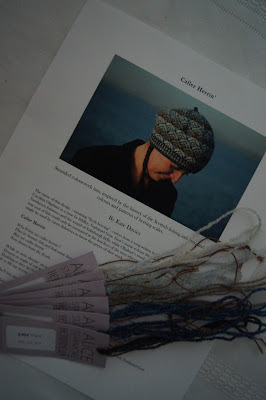
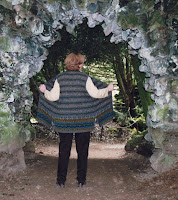
From the back - see the little i-cord knot? It was hot today - but I felt I needed some scottish wool around me - so I draped one of my tartan scarves around my shoulders. Pattern:  Caller Herrin' by Kate Davies   (Read about her design inspiration - at Needled , her blog. ) Yarn:   Virtual Yarns Hebridean - original shades as per pattern Modifications:  One full repeat of the motif on the round (as suggested in the pattern) with additional increase stitches (as per the pattern) with an additional 6 rounds added to the main body of the hat before starting the decreases for the top. I also did a little I-cord celtic knot (rather than the loop as suggested by the pattern). I did NOT do the lining on the corrugated rib or the I-cord edging - I may still go back and do this after I've done a little research with the other knitters on Ravelry that have done this hat.  I'm worried that it would make the rib too tight for me. It is suggested that if you want t...

Blocking

Image
My Caller Herrin' will be a tam - washed in Eucalan and blocking right now.

Almost done.....

Image
I'm at the very top of the hat - it's finished off with an i-cord loop. I love this mobile blogging - quick and easy - sort of like tweeting with photos.

A better view.....

Image
Of magic loop...ing

Magic Loop

Image
I used to do "the" magic loop method before I knew it was "magic"......very useful when you're at the top of a hat

New Favourite Blog....

Image
While doing a big of Ravelry research on Caller Herrin.......looking at all of the projects, reading notes (I wish more knitters put more notes in their project details).......I came across this blog...... It's now on my bloglines list. My swatch is done - it has been washed in Eucalan and is drying right now - I will measure it and go from there.

Starting a project......

Image
This post got buried in my post list as a draft - it should have announced the start of my Caller Herrin' knit - and here it is July 12 - a bit late as I am ready for the Applöse post! Stranded (fair isle) projects usually use many shades of yarn.  One of the subtlties of "fair isle" knitting is the multitude of shades available in the traditional yarns. So, the first thing to do when starting a multi-coloured project is to wind the yarns (if they come in skeins) and to make yourself some kind of shade legend - make it easy for you to see which shade is which. So I'm ready to start Caller Herrin' - in this case the yarn used in Alice Starmore's Hebridean yarn.  This yarn comes in 35 luscious shades - and you'd think that with "only" 35 shades it would be easy to tell them apart - but these yarns are gorgeous heathered yarns - and the shades used in Caller Herrin' are similar....so to make it easy for me, I took lengths of yarn and threaded ...

Suggestions....

Image
For first time fair isle (stranded) projects - hats are great - circular knitting going round and round.....so here are a few suggestions....... Freebies: Fair Isle Tam in Patons Classic Wool  - from the Patons site Winter Forest Tam - knit in traditional Jamieson's Shetland Spindrift - gorgeous traditional tam - a Ravelry download Béret généreu x  by Isabelle Allard - a tam in worsted weight - a Ravelry download Nordic Sweetheart Hat If you want a lot of practice- try my Nordic Sweetheart Hat - done in Jamieson's Shetland Spindrift - or fingering weight - this is a double layered hat - that when folded up provide 4 layers over your ears - a traditional Norwegian design. If you are on Ravelry (why not, it's free) you can do a pattern search for a hat, stranded, knit in the round and look at all of the choices -- I would suggest something with small repeat patterns - not something that has bigger motifs (like skulls or other alien beings LOL!) because you want to learn ho...

Does it really matter?

Image
When doing two handed stranded knitting, does it really matter what yarn you carry in which hand? Well....you decide. Your practice knitting - when holding yarns in both hands - knit with the yarn from your right hand - then when you knit with the yarn in your left hand it automatically comes from underneath - and when you knit stranded (aka fair isle) you knit along like that, never twisting......so all you have to do is decide which stitches on your chart you are going to knit with the right (top) yarn.....or the left (bottom) yarn. Some knitters decide round by round - knitting the shade that is most used in the round with their dominant hand.  This means that they will be changing the position (top or bottom) of the yarns depending on the motif. What I'd like to demonstrate here is that it is your choice - but you must be aware of the position of your yarns and maintain that position throughout your project. For these two swatches, I used Jamieson's Shetland Heat...

Poll Results

Image
Cones of yarns at the Jamieson's Spinning Mill in Shetland As a "Fair Isle" Knitter - I consider myself to be.... Experienced - I know it all! - 3 (7%) Intermediate - I do knit fair isle - but I'd love some tips to refine my technique - 30 (76%) Beginner - I've never tried or have tried and gave up - 6 (15%) Thank you to all of you who responded. Next subject - which hand hold which yarn - does it matter? What do you think - comments welcome!

FI101 - Charts

Image
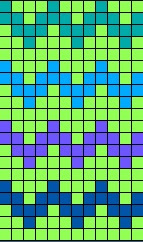
Charts for colour knitting come in many forms - look at the fair isle charts you have on hand. When knitting Fair Isle IN THE ROUND, charts are read right to left, bottom to top. When knitting Fair Isle back and forth, in flat pieces, you will follow your chart, bottom up, reading the right side rows from the right, and the "back side" rows from the left.   (Note:  If your piece is totally symmetrical, this actually won't matter....and you will be able to read the "back side" rows right to left if that makes more sense to you!) Charts may have the stitch numbers and row numbers running along the bottom and up the side of the chart. Here is the same simple chart - presented in 3 different formats. Some charts are done in full colour - it's easy to visualize the design, but I find that sometimes it's hard to decide exactly which yarn is to be used where - especially if the design uses many shades of one colour. Some charts use symbols fo...

How's it going?

Image
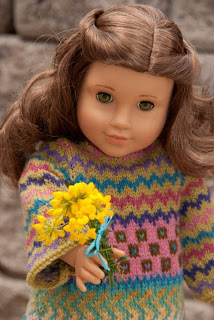
This is an American Girl doll dress that I knit for a friend's daughter and I'll use it as a basis for the sample size designs for practice knitting. Those of you who are practicing with their opposite hand - how's it going? So now that your other hand is becoming more comfortable with knitting too.....we can proceed to knitting with two shades of yarn at the same time - stranded knitting. You have two hands - and two shades of yarn - hold one yarn in each hand - now knit one stitch with your right hand - one with your left - carry on knitting like this until it feels good. Then 2 stitches with the right and 2 with the left..... Then 3 with the right and 3 with the left.... etc - up to 5 or 6 stitches with each hand. You knit always keeping the yarns separate - never twisting - the yarn in your right hand knits running along the top - the yarn in your left hand always comes from underneath - pops up to knit - then drops back down while the right hand knits. As you add stitc...

New Poll - Rate Yourself!

Image
One of my earliest designs - abandoned.......then recycled to take part in the Cambridge  Project What is your experience level as a Fair Isle Knitter - Experienced, Intermediate or Beginner - please vote on this new poll. Those of you who consider yourself to be Beginners - do you have anything specifically that you'd like to see detailed in the future? Intermediate Fair Isle knitters - you've done some Fair Isle in the past - what aspects of the knit were you thinking....there must be a better way? perhaps you'd like to have this issue specifically addressed? You Experienced Fair Isle knitters - as this tutorial goes on - I'd love it if you'd post your opinions or alternatives to what I post.....after all....there is never only one way to do something..... Your participation in this tutorial is crucial to making it a worthwhile experience for all of us.  I look forward to your comments and suggestions. Anne

How do you knit? Poll Results

Image
I throw with my right - 13 (26%) I knit continental - yarn in the left hand - 15 (30%) I can do both! - 25 (50%) and nobody said they used another style of knitting! Thank you to the 50 readers who responded to this poll.                                                                                                                                                                      Congratulations to the lucky knitters who can do both - you probably already knit fair isle (aka stranded) knitting projects using both hands - one yarn in each - do you? Or do you favour one hand ov...

Fair Isle or Stranded - what's the difference?

Image
While we are waiting for the Poll "How Do You Knit" to finish...... see Vogue Early Fall 2011 post The following is my opinion only - feel free to disagree! A design based on the traditions of Fair Isle Knitting - OXO and pirie motifs, knit in the round  incorporating steeks in the construction, using traditional Shetland yarns What makes it a Fair Isle versus stranded.... well, Fair Isle is.... a specific style of knit garment (not a knitting technique) knit in the round  using the traditional Shetland jumper weight (fingering) wool yarns (from the Shetlands - Shetland sheep raised in the Shetland Islands) uses only two shades per round uses traditional OXO and pirie motifs therefore does not have long carries of the yarn being carried (stranded) across the back incorporates the steeking method (although many Shetlanders knit back and forth above the armholes) Do I have proof of the above statements - No, I don't. This is my def...

Vogue Early Fall 2011

Image
When Lee Ann contacted me earlier this year - way earlier - about the "Made in Canada" column in Vogue Knitting - to be honest, I was in a knitting slump.  It had been a long winter.  Our traditional Canadian cold winter, which is hard to handle sometimes was made even more tedious by the lack of a winter vacation.....remember St. Lucia last year ?  I certainly do!!!! I was trying to decide what knitting path to forge down next...and Lee Ann's call reminded me of my FI 101 Class that I originally put together for an on-line group called Knitting Beyond the Hebrides.   (I'm not sure how active this group still is....I put myself on hold at one time and honestly forgot to reactive myself - if anyone reading this knows.....let me know either in a comment or by e-mail ok?) So, in honour of the honour of being reported on in this issue of Vogue Knitting....I propose to revive my Basics of Fair Isle on-line tutorial (my FI 101 Class) here....new videos and photos....inco...